

What Makes Minelab Gold Detectors Different from Other Brands

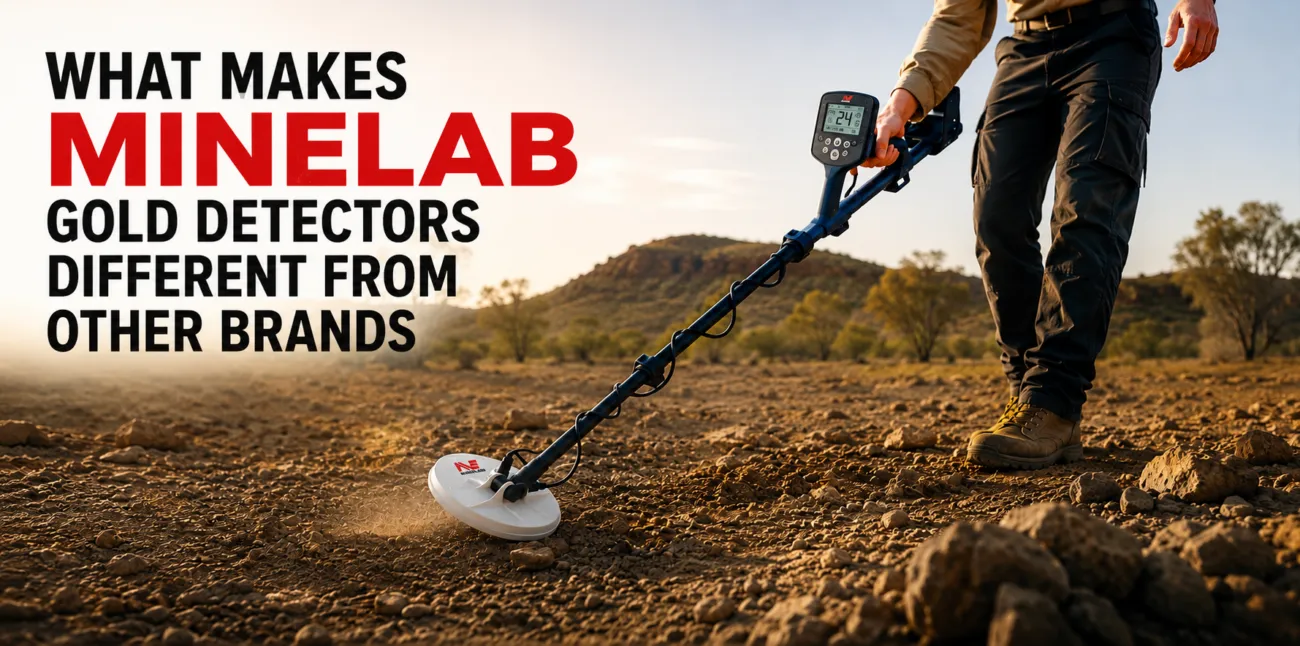
Picture this: You are standing under the blazing sun in a rugged, iron-rich desert tract of Rajasthan. The ground beneath your boots is choked with heavy red clay and hot rocks. To your left, another prospector is swinging a cheap gold detector machine. Every two seconds, his machine lets out a loud, chaotic chirp. He stops, digs excitedly, and pulls up nothing but a rusted iron nail or a piece of magnetic hot rock. Frustrated, he drops his shovel.
Meanwhile, you pass your coil over the same patch of ground with a premium Minelab machine. Your threshold remains dead silent—until a smooth, unmistakable low-low tone cuts through your headphones. You dig down six inches, flip over a clod of heavy clay, and there it is: a pristine, raw gold nugget.
That is not luck. That is engineering. If you are serious about hunting treasure, you need to understand that gold does not just sit in clean, pure sand. It hides in the worst, most hostile environments on earth. Let’s look at why a premium gold detector machine from Minelab stands completely isolated from the competition.
Why Cheap Gold Metal Detectors Fail in Mineralised Ground
Most generic brands design their machines to look flashy on paper, but they crumble the moment they touch real gold country. Gold naturally forms in areas filled with high concentrations of iron oxide, volcanic hot rocks, and black magnetic sands. This is what we call heavily mineralised ground.
When a standard, low-cost gold metal detector transmits its signal into this type of soil, the ground itself acts like a massive wall of metal. The cheap gold and metal detector becomes completely blinded by the surrounding iron particles. As a result, it either screams continuously with “false signals” or shuts down its sensitivity entirely to stay quiet. When a detector loses its sensitivity to stop the chatter, it passes right over deep gold without ever knowing it was there. Cheap machines are essentially blind in the very places where gold actually lives.
Minelab’s Core Tech: GPX, Multi-IQ, and Pulse Induction Explained Simply
Minelab did not become the industry leader by accident. They spent decades developing advanced, proprietary technologies designed to ignore the ground and focus entirely on the target.
Very Low Frequency (VLF) vs. Pulse Induction (PI)
Traditional entry-level detectors use VLF technology, which sends a continuous single wave into the earth. While great for clean park soil, VLF struggles in heavy mineralisation. To beat this, Minelab perfected Pulse Induction (PI) technology, found in their legendary GPX series.
Instead of a continuous wave, a PI machine shoots rapid, powerful bursts of magnetic energy into the ground. When the pulse turns off, the ground mineralisation signal dies away almost instantly, but the signal from a real gold nugget lasts a fraction of a second longer. The detector listens during that tiny window of silence, making it the best gold detector machine to find deep gold that other brands leave behind.
Multi-IQ: Simultaneous Multi-Frequency
For their more versatile lineups, Minelab introduced Multi-IQ technology. Instead of forcing you to hunt with just one single frequency, Multi-IQ transmits a broad spectrum of low, medium, and high frequencies all at the same moment.
- High Frequencies: Catch the tiniest sub-gram targets near the surface, acting as a highly sensitive gold nugget detector.
- Low Frequencies: Punch deep into the earth to find massive buried treasure.
By blending these frequencies simultaneously, a single sweep gives you the coverage of multiple machines working in perfect harmony.
Ground Balancing: Why Most Brands Get This Wrong
Ground balancing is the process by which a detector measures the mineral content of the soil and subtracts it from the equation, ensuring the machine only alerts you when it detects a real target.
Most generic brands use fixed or slow automated ground balancing. As you walk across a riverbed or an outback path, the soil composition changes every few steps. A generic gold detector cannot keep up. It falls out of balance, starts chattering, and forces you to constantly stop and manually reset the machine.
Minelab utilises ultra-fast, dynamic tracking ground balance. Their processors continuously read the changing ground mineralisation hundreds of times per second. If you step from dry sand onto wet, iron-heavy clay, the machine self-adjusts seamlessly. You maintain maximum depth and absolute silence without ever pushing a button.
Minelab vs. Generic Brands: The Reality Check
Let’s look at how a high-quality Minelab gold detector stacks up against a generic alternative when you are out in the field looking for a high-performance underground gold detector.
| Feature | Minelab Gold Detectors | Generic Brand Detectors |
| Depth in Bad Soil | Retains exceptional depth via PI and Multi-IQ | Loses up to 80% of depth in mineralised ground |
| Target Separation | Distinguishes iron trash from gold instantly | Masked by iron; misses gold next to trash |
| Build Quality | Military-grade, often fully waterproof | Fragile plastic shafts, prone to water damage |
| Warranty & Support | Full official warranty with dedicated support | Zero local repair options or spare parts |
The Field-Ready Prospecting Checklist
Before you look through any gold detector machine for sale, make sure your next machine checks all of these boxes:
- Does it have true Pulse Induction or Simultaneous Multi-Frequency
- Can it handle salt and high iron mineralisation without losing depth
- Is there a reliable local service centre for maintenance and parts
- Does it include dynamic, automatic ground tracking
Gold Detector Machine Price: Is Minelab Worth the Investment?
Let’s address the elephant in the room: the gold detector machine price. Minelab machines are undeniably a premium investment. However, looking purely at the initial cost is the wrong approach. You must look at the return on investment. A cheap machine that finds zero gold is expensive. A premium machine that successfully locates gold pay-streaks pays for itself on your first major discovery.
When analysing the gold detector machine price in india, buyers face unique environmental realities. India’s prominent prospecting grounds—ranging from the ancient riverbeds of Karnataka to the mineralised desert tracts of Rajasthan—possess incredibly challenging, high-iron soil matrices. A generic machine will simply fail here.
Furthermore, Minelab backs its premium price point with rock-solid consumer protections. Every machine comes with an official manufacturer’s warranty and comprehensive after-sales support. If you ever need technical calibration or an accidental component replacement, you will not be left with a useless piece of plastic. You are investing in a durable, professional gold detector built to last for generations.
Which Model Suits Beginners vs. Professionals?
Choosing the right tool depends entirely on your experience level and your targeted terrain.
For Beginners and Intermediate Hunters: Minelab X-Terra Voyage or Gold Monster 1000
If you are just getting started, you do not want to be overwhelmed by complex audio settings. The Gold Monster 1000 features fully automatic operation, high-frequency performance, and an easy-to-read gold chance indicator. It simplifies the process so you can focus on mastering your swing technique.
For Serious Seekers and Professionals: Minelab GPX 6000 or GPZ 7000
When your livelihood or a massive investment depends on finding gold, a premium professional gold detector like the GPX 6000 is the undisputed king. Powered by GeoSense-PI™ technology, it continuously analyses ground signals with absolute precision, allowing you to use maximum sensitivity with minimal noise. It finds tiny gold flakes and massive, deep nuggets that every other brand leaves behind.
Best Terrain for Minelab: Where the Tech Shines
Minelab engineers specifically test their equipment in the harshest landscapes on the planet to guarantee flawless operation.
- The Desert: In hot, dry expanses filled with shifting sands and underlying volcanic rocks, Minelab’s advanced heat-shielded coils and pulse tech keep performance perfectly stable.
- Riverbeds and Waterways: Gold collects in the tight bends of mountain rivers and streams. Waterproof models like the Equinox or CTX 3030 allow you to wade right into the water, ignoring heavy, wet salt and black sand deposits.
- Mineralised Outback & Farmland: Old agricultural land is often packed with iron trash, square nails, and rusted fence wire. Minelab’s superior target discrimination lets you ignore the junk and pinpoint the historical gold and relics hidden beneath.
Who Should Buy a Minelab Gold Detector?
- The Career Prospector: Anyone who relies on finding gold consistently to generate income or fund their operations.
- The Harsh Terrain Explorer: Hunters targeting areas known for extreme iron mineralisation, black sand, or high salt concentrations.
- The Efficiency Seeker: Anyone who wants to stop wasting time digging up old iron trash, soda cans, and false ground signals.
- The Long-Term Investor: Buyers who want a durable machine backed by an official warranty, certified repair centres, and a high resale value.
Shop with Gold Detector India
Don’t leave your discoveries to chance or waste your valuable time swinging a machine that leaves the best treasures hidden in the dirt. Visit golddetectorindia.com today and find the rightgold detector machine for your terrain, your budget, and your next big find — before someone else beats you to it. If you have any questions or need expert advice on selecting your gear, contact us today to speak with a seasoned prospecting specialist.
Visit Gold Detector today and get top quality for less!
Frequently Asked Questions
1. Can a regular metal detector find gold nuggets?
Most standard coin or relic detectors operate at low frequencies designed for highly conductive metals like silver or copper. They will pass right over small gold nuggets without making a sound. You need a dedicated machine with high frequencies or pulse induction to pick up raw gold.
2. Why does the gold detector machine price vary so much between models?
The price reflects the processing technology inside. Entry-level machines use basic single-frequency tech, which works well in low-mineral soil. Professional models use advanced Pulse Induction (PI) and high-speed microprocessors to filter out extreme ground noise and reach incredible depths.
3. Is it difficult for a beginner to use a professional Minelab machine?
Not at all. While models like the GPX 6000 are advanced, they feature highly intuitive, automated settings. The machine handles the ground balancing and noise cancellation internally, making it surprisingly easy for a beginner to turn on and start hunting.
4. How deep can an underground gold detector detect?
Depth depends on nugget size and soil conditions. Small gold flakes can be found up to several inches deep, while large nuggets can be detected several feet down by advanced Pulse Induction machines that punch straight through harsh soil.
5. Where can I get official support and see a genuine gold detector machine for sale in India?
Always purchase through certified, authorised channels like Gold Detector India to guarantee your official warranty protection. Certified platforms provide direct access to genuine spare parts, expert troubleshooting, and factory-authorised technicians.